Without being aware of it, people probably walk by and even use several LEM current sensors each day. Current sensors are present in elevators, forklifts, machines tools, printing machines and in all equipment using industrial drives on motors for efficient control, regulation, energy saving and comfort.
Drives control requires reliable and accurate current measurement to enable engineers to develop systems with isolated current measurement directly on the motor phases.
Enhancing Energy Efficiency and Control in Industrial Drives Applications
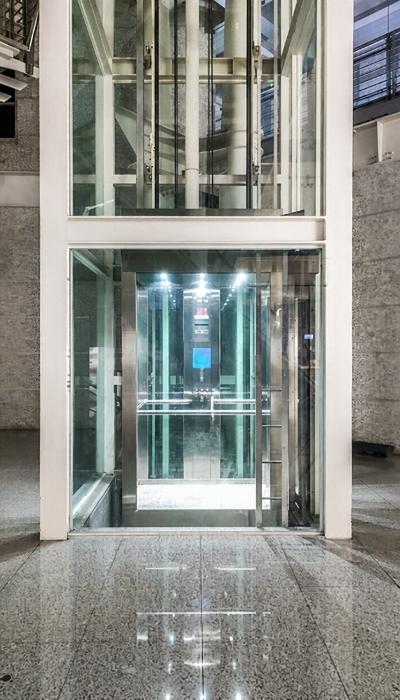
In today's current sensor market, two key technological drivers stand out: the pursuit of greater comfort and finer regulation, and the imperative to save energy. This shift is evident as many applications used to rely on mechanical systems and now transition to fully electronic control, offering enhanced reliability, improved regulation, and greater energy efficiency.
In inverter control systems, precise and reliable current measurement is essential for engineers to develop isolated current measurement directly on motor phases. LEM products are already widely employed across various power electronics applications, including industrial motor drives, UPS, welding, robotics, cranes, cable cars, ski lifts, elevators, ventilation, air-conditioning, power supplies for computer servers, and telecom.
This shift towards more sophisticated power electronics is spreading across industrial sectors. By delivering the right type of power at optimal voltage, current, and frequency, power electronics enhance overall efficiency.
Current sensors play a vital role in this scenario by accurately measuring constantly varying currents to provide feedback for control purposes. For instance, in a machine tool, current flow increases abruptly when the tool engages with the workpiece. A prompt and precise feedback signal enables smoother control of equipment operation.
Typical applications for industrial drives include:
- Lifts
- Escalators
- Cranes
- Wheel Chairs
- Forklifts
- Electric door opening systems
- Robots
- Pumps
- Steel Mills
- Machine tools (Printing paper, textile, plastic)…
Efficient Design and Functionality of Electric-Powered Elevators
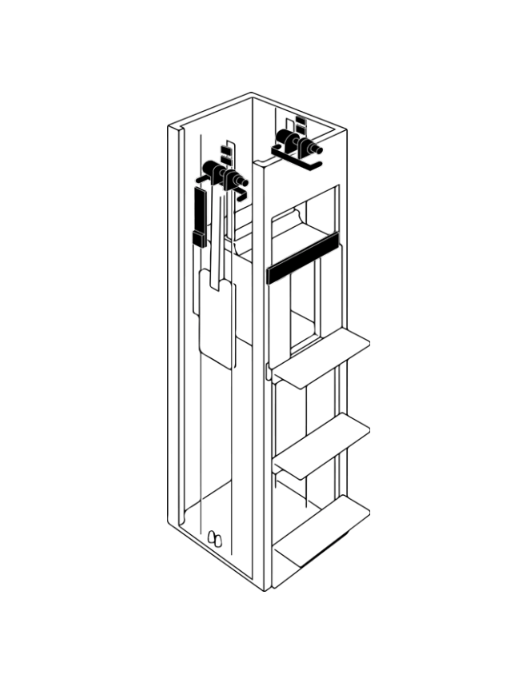
Elevators are generally powered by electric motors that either drive traction cables or counterweight systems like a hoist.
Machine room-less elevators are designed so that most of the components fit within the shaft containing the elevator car. A small cabinet houses the elevator controller and the motors.
The motor is controlled by an inverter and a controller. As soon as someone pushes a button to request the elevator, the controller gives the necessary signals to the inverter. It then moves the motor in the right direction and lets it stop exactly at the right position to the floor ground independent of the weight in the elevator car. The elevator current sensors take care that the motor is powered with the correct current.
Elevator doors protect riders from falling into the shaft. The most common configuration is to have two panels that meet in the middle and slide open laterally. The doors are controlled by a control unit that integrates the motors of the sliding doors and the protection of the riders. The elevator sensors measure the current in the motors for two purposes: to run the panels smoothly and to discover if something (e.g., a finger, a leg) obstructs the doors in which case the closing would be stopped.
The role of sensors in precision control of Industrial Robots
A robot is an electromechanical machine that is guided by computer and electronic programming. Robots can be autonomous, semi-autonomous or remotely controlled. Robots range from humanoids to nanorobots and industrial robots.
Industrial robots usually require movements in 3-6 axes in order to move the end of the arm in every position. Typical applications of robots include welding, painting, assembly, pick-and-place (such as packaging, palletizing and SMT), product inspection, and testing; all accomplished with high endurance, speed, and precision.
The robot arm is moved by electrical servo motors: usually one motor for each axis. The motors are controlled by a power inverter that receives its signal from a motion control unit. In order to control the arm, the power inverter drives the motor from one position to the next and stops precisely in position. To do so, an accurate measurement of the current is needed.
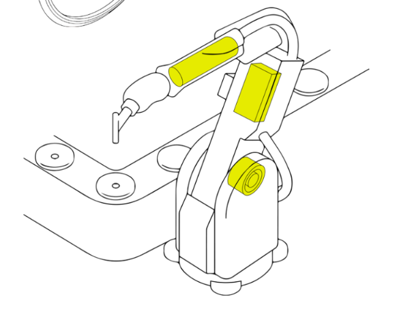
Current sensors in an industrial robot application
Transducers are used to measure the current and, together with the position sensor, they are responsible for controlling the fast movement and the precision to stop the arm in the new position. The motion control unit also contains the memory used to store all the positions required for this work.
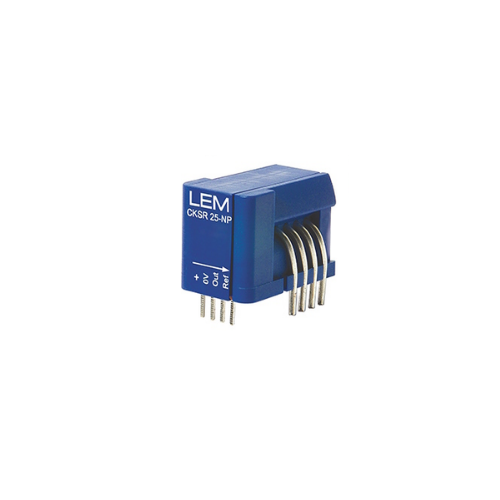
CKSR Series
- Very low temperature coefficient of offset
- Very good dv/dt immunity
- LKSR compatible footprint
- Reduced height
Current Sensors solutions for Industrial Drives
LEM provides a diverse array of high-performance solutions tailored for industrial drive applications. Our products are specifically engineered for use in robots, elevators, forklifts, and other motor drive systems, guaranteeing optimal efficiency, reliability, and control.
| Bandwidth | 200kHz | 200KHz | 200KHz | 300kHz | 90kHz - 450kHz | 300kHz | 1000kHz | 200kHz | 300kHz | 100kHz - 350 kHz | 200kHz | 100kHz – 200kHz | 50kHz | 20H – 6000Hz | 180kHz | 150kHz | 200kHz | 1000kHz |
| Current Range Max | 150A | 180A | 1050 A | 10A – 75A | 25A – 300A | 10A – 75A | 125A - 250A | 180A | 20A – 150A | 15A - 625A | 380 A | 55A – 200A | 150A – 900A | 600A – 1800A | 250A – 1400A | 500A - 2000A | 4500A | 9000A |
| Input Voltage | 5V | 5V | 12V / 15V / 24V | 3.3V – 5V | 3.3V – 5V | 3.3V – 5V | 3.3V - 5V | 5V | 5V | 5V | 4.75V – 5.25V | 12V – 15V | 15V | 20V – 50V | 3.3V – 5V | 3.3V – 5V | 12V – 15V – 24V | 12V - 24 V |
| Mounting | PCB | PCB | PCB, Panel | SOIC8 | PCB | SOIC16 | PCB | PCB | PCB | PCB, Panel | PCB | PCB | Panel | Panel | Panel | Busbar, Panel | Panel, PCB | Busbar |
| Output | Voltage | Voltage | Current | Analog | Voltage | Analog, Digital | Voltage | Voltage | Voltage | Voltage | Voltage | Current | Voltage | Voltage / Current | Voltage | Voltage | Current | Voltage / Current |
| Overall Accuracy | 1% | 0.8% - 1% | 0.4% - 1.4% | 1.3% - 3% | 1% | 1% - 3% | 1.2% - 1.45% | 0.4% - 1% | 0.5% - 0.7% | 1% - 1.35% | 0.83% | 0.3% - 0.41% | 1% - 1.25% | 1% | 1% - 1.25% | 1% | 0.2% - 0.6% | 0.5% |
| Technology | Closed Loop Fluxgate | Closed Loop Fluxgate | Closed Loop Hall Effect | ICS | Open Loop Hall Effect | ICS | Open Loop Hall Effect | Closed Loop Hall Effect | Closed Loop Hall Effect | Open Loop Hall Effect | Closed Loop Hall Effect | Closed Loop Hall Effect | Open Loop Hall Effect | Open Loop Hall Effect | Open Loop Hall Effect | Open Loop Hall Effect | Closed Loop Hall Effect | Open Loop Coreless |
Certificates and standards
Compliance with the highest industry standards
LEM products and processes comply with reference standards in the industry:
- CE marking of LEM transducers in recognition of their electromagnetic compatibility
- IEC standards for drives applications:
- IEC 61800-5-1 for safety
- IEC 61800-1 & IEC 61800-2 for climatic and mechanical constraints
- IEC 61800-3 for EMC
- RoHS compliant
- ISO TS 16949 certification of all production and development centers (Switzerland and China)
Quality products and services: our priority
Based on our deep knowledge of applications and current measurement technologies, LEM develops both catalog and customized products which can be perfectly tailored to meet your needs in terms of performance, space requirement and cost.
PRODUCT DOCUMENTATION
Explore the cutting-edge technologies LEM offers for industrial automation applications. Delve into the specifics and download our brochure for a comprehensive understanding:
Application Guide: Find the Right Sensor Faster

Explore a wide range of real-world applications and discover how current and voltage sensing technologies are integrated into modern system architectures.
The LEM Application Guide combines application block diagrams, sensing insights, and recommended products to help engineers and developers identify the right solution and accelerate their design process.
NEED SUPPORT ON YOUR PROJECT?
You have a project in line with that application and want to discuss it with LEM?
Click on the contact button below and our experts will help you find the best solutions for your needs.